When you commission a kitchen, wardrobe or bespoke piece of furniture, one of the most important decisions is the choice of material. Cabinet doors determine how the furniture looks, and they are among the surfaces touched most in daily use.
Choosing the right material is more than picking a colour or texture you like. You also need to weigh the durability of the surface, how easy it is to clean, how it behaves with moisture and heat, how heavily it will be used and your budget.
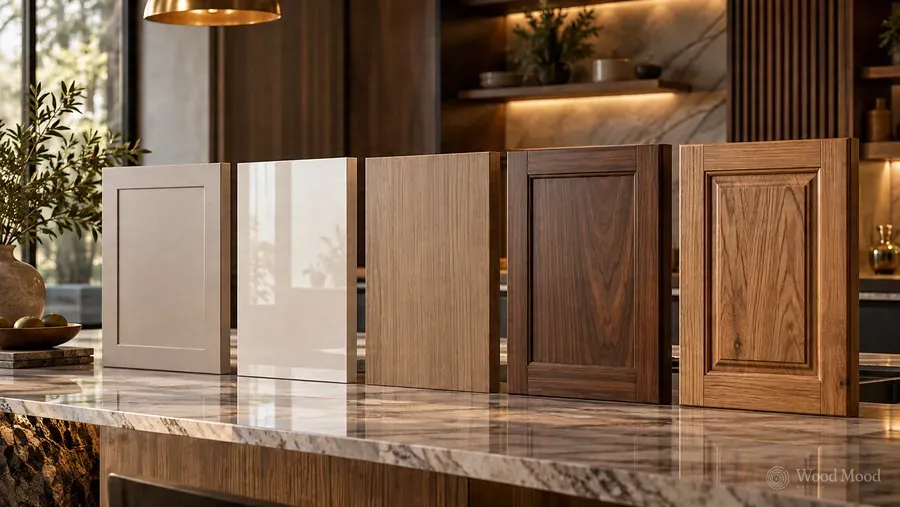
Lacquer, acrylic, natural wood veneer and solid wood each have different properties and design possibilities.
So which material should you choose for your cabinet doors? What are the differences between matt and glossy finishes? And what else decides how long the furniture lasts?
In this guide we compare the materials used for cabinet doors, the carcass options, edge details and worktop surfaces, to help you make the right choice.
The difference between the door and the carcass
A cabinet is made up of two main parts: the carcass and the door.
The carcass is the structural frame of the cabinet, made up of the side panels, shelves, base and top. Strength, joint quality and a material suited to where it will be used all matter here.
The doors set the outward look of the furniture. Colour, texture, sheen, edge finish and decorative details all follow from the door material.
The carcass and the doors therefore do not have to be made from the same material.
For example, a suitable wood-based panel can be used for the carcass, with lacquer, acrylic or natural wood veneer for the doors.
What matters is that the materials are compatible with each other and suited to the conditions where they will be used.
Lacquered cabinet doors
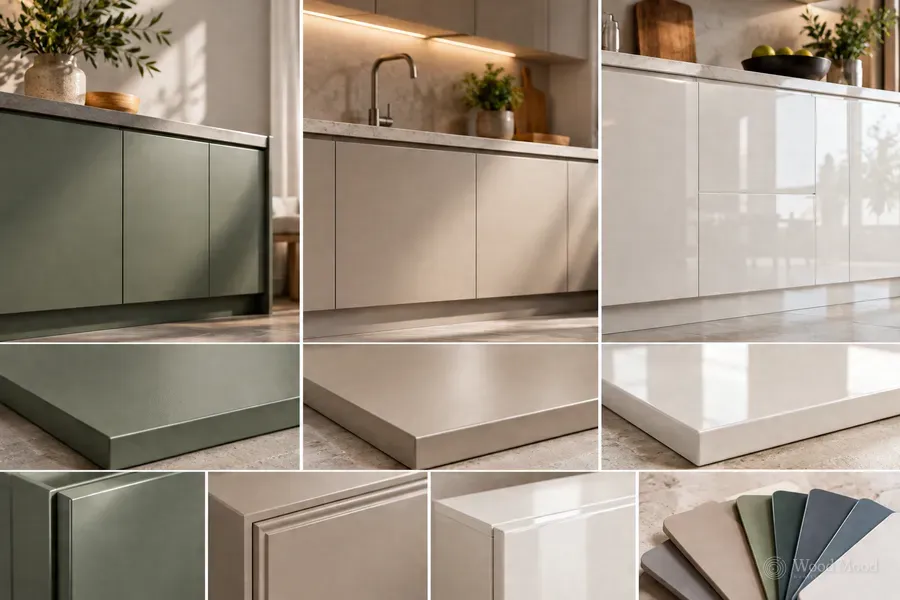
Lacquered doors are usually made by applying a suitable primer, paint and topcoat to an MDF surface.
One of their biggest advantages is the wide choice of colour. Designs can range from light cream tones to anthracite, and from natural colours to bolder alternatives.
Lacquered surfaces can be made in matt, satin or high-gloss finishes.
Advantages of lacquered doors
With lacquer, the edges of the doors can be painted along with the front face. This gives a unified look between the surface and the edges.
Because channels, frames and other decorative forms can be worked into the MDF, you are not limited to flat doors.
Different door styles can be made for modern, classic and bespoke furniture.
Some damage to lacquered surfaces can also be repaired by suitable methods, or the door can be resprayed.
What to watch for
The surface quality of lacquered doors depends on the paint system used and the standard of workmanship in applying it.
Fingerprints and fine scratches can show more on glossy surfaces in particular.
On matt lacquer, hard and abrasive cleaning products can over time cause local changes in sheen.
For daily cleaning, use soft cloths and products suited to the properties of the surface.
Acrylic cabinet doors
Acrylic doors are usually made by applying a decorative acrylic surface layer to MDF.
With their smooth, modern look, they are popular for kitchen units, wardrobes and other storage units.
Glossy acrylic surfaces reflect light strongly, while matt acrylic options give a calmer look.
Advantages of acrylic doors
Thanks to their even, uniform look, acrylic surfaces work well in simple designs.
In modern kitchens with flat doors in particular, handleless units can give a unified look.
With a range of colours and sheen levels, they can suit light or dark furniture designs.
What to watch for
The scratch and impact resistance of acrylic surfaces varies with the technical properties of the product used.
On glossy options, fingerprints and small marks on the surface are easier to see.
The colour, thickness and quality of application of the edge banding or finish used on the door edges also affect the look of the finished furniture.
It is therefore worth judging the edge joints on a sample as well as the door surface.
Natural wood veneer cabinet doors
Natural wood veneer is made by applying a thin layer of real timber to a suitable base such as MDF.
This brings the wood’s own grain, colour variation and natural texture to the furniture.
Different species such as oak, walnut and ash give quite different looks.
Advantages of natural wood veneer
The most distinctive feature of natural wood veneer is that every surface has its own grain.
This gives the furniture a character that standard decorative finishes do not have.
By planning the veneer direction and grain continuity, doors that sit side by side can look unified.
Natural wood veneer is a strong design choice, especially on large wardrobe fronts, TV units and modern kitchens.
What to watch for
The look of natural wood veneer depends on the species used and the protective finish.
Wood can change colour in sunlight over time. This is mostly down to the natural properties of the material.
Because the veneer layer is thin, deep scratches and knocks are harder to repair than on solid wood.
It is important not to expose the surface to water for long and to protect it with suitable cleaning methods.
Solid wood cabinet doors
Solid wood doors are made by working pieces of natural timber and joining them using suitable methods.
It is a material that lets you feel the texture, weight and natural character of the wood directly.
It is popular in classic and rustic designs and wherever natural materials take centre stage. It can also be used in modern furniture with simple lines.
Advantages of solid wood
With its own grain and natural variations in colour, solid wood gives every piece of furniture its own character.
Depending on the type of finish, it can be sanded, repaired and given a new protective finish over time.
With the right design, suitable manufacturing and regular care, it can be used for many years.
What to watch for
Solid wood is a natural material that can expand and contract with the humidity around it.
The movement of the wood must therefore be allowed for, especially in wide doors. Framed door designs and suitable construction methods help manage this movement.
Direct sunlight, excess moisture and strong heat sources can also affect the look and dimensional behaviour of solid wood.
How do you choose between matt and glossy finishes?
After colour, one of the decisions that most affects how furniture looks is whether the surface is matt or glossy.
Both options have their own advantages.
Matt surfaces
Matt doors reflect less light and give a calm, balanced look.
They are popular with natural wood textures, earth tones and simple design lines.
Not every matt surface has the same properties, though. On some products fingerprints are barely visible, while on others contact marks can show more on dark surfaces.
Ease of cleaning and surface durability should be judged from the technical properties of the material used.
Glossy surfaces
Glossy doors reflect light and make the furniture stand out more.
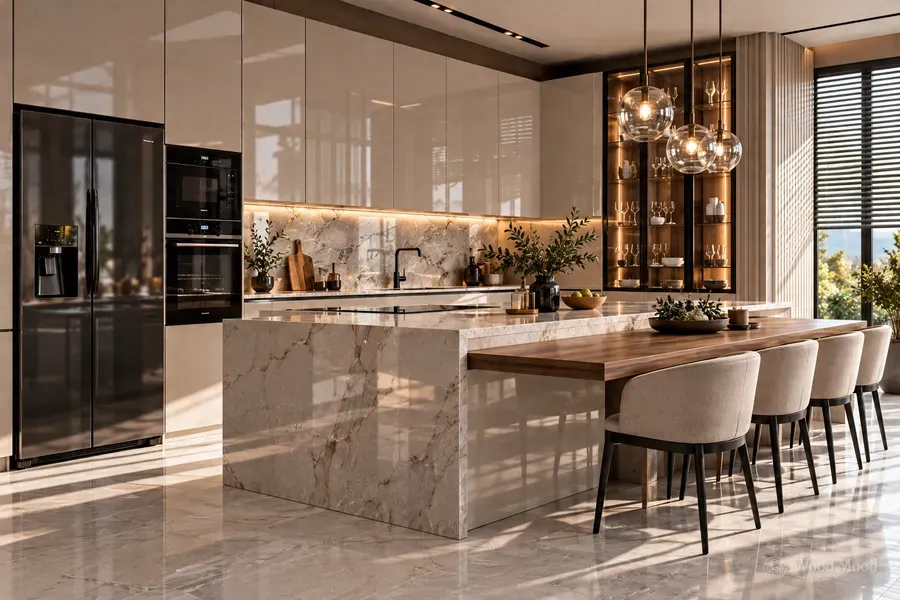
They can create a bright, modern effect, especially in light-coloured kitchens.
On surfaces that get direct light, however, reflections, fingerprints and fine scratches can be more noticeable.
When choosing, therefore, consider the lighting in the kitchen and how heavily it will be used, as well as which finish you like the look of.
Glass-fronted cabinets
Glass doors are a complementary option, used especially in decorative display cabinets, kitchen wall units and dressing rooms.
They can be used with wooden or suitable metal frames.
Clear, smoked, frosted or decorative patterned glass gives different looks.
The main advantage of glass doors is that they show what is inside the cabinet, which gives the furniture a lighter look.
With optional LED lighting inside, glasses, decorative pieces or personal accessories can be put on show.
When choosing glass, take the door size, the fixing system and the safety requirements into account, and use suitable safety glass.
Remember at the design stage that the arrangement inside the cabinet will be visible behind clear glass doors.
Carcass materials
The look of the doors comes first, but the strength and comfort of use of the furniture depend largely on the carcass.
Choose the carcass material according to the size of the cabinet, the load it will carry, the humidity of its surroundings and the joint details.
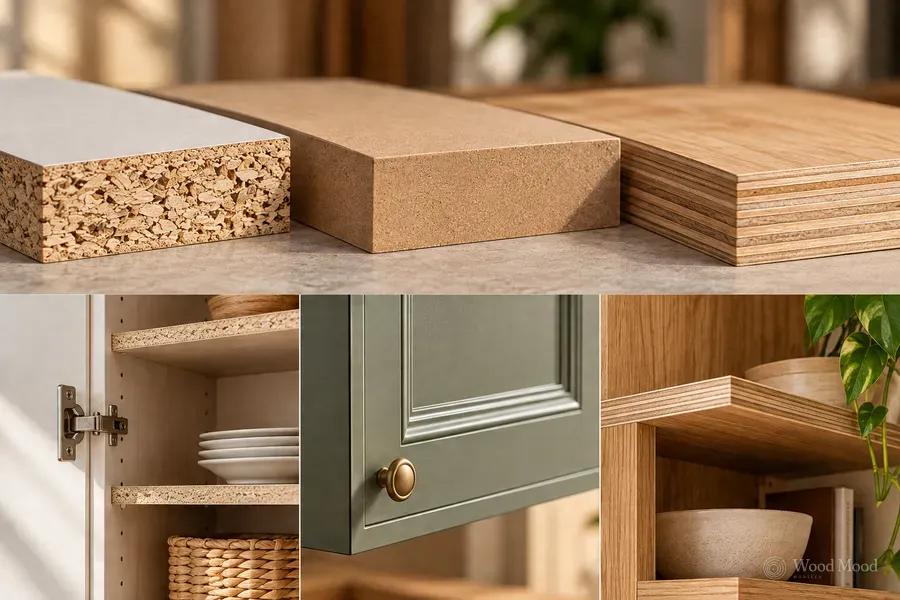
Chipboard
Chipboard is made by pressing wood particles with suitable binders.
Versions with a decorative surface are widely used for cabinet carcasses.
It is an economical solution and gives smooth, even surfaces.
The screw fixings, edge details and load-bearing dimensions should be planned to suit the properties of the material.
MDF
MDF is a uniform panel material made from wood fibres.
Its smooth surface suits paint and other surface finishes.
It is the usual choice for lacquered doors, for surfaces with decorative channels and for specially shaped furniture parts.
Thickness, density and the technical class of the panel should be chosen for the application.
Plywood
Plywood is made by bonding thin layers of wood with the grain of each layer running in a different direction.
Plywood of the right grade and quality can be used in a range of load-bearing furniture applications.
The layered edge can also be left visible as a decorative feature in some modern designs.
The strength and moisture behaviour of plywood depend on the timber species, the adhesive system and the manufacturing class.
Why moisture-resistant materials matter
In areas such as kitchens, bathrooms and utility rooms, furniture is exposed to moisture and splashes more often.
The carcass materials must therefore be chosen to suit the conditions of use.
Moisture-resistant MDF and other wood-based panels of a suitable class can be better suited to damp conditions than standard products.
However, moisture-resistant does not mean completely waterproof.
Water must be kept from reaching the material, especially under sinks, at pipe penetrations and on exposed edges.
As well as choosing the right material, edge sealing, joint details and the quality of the installation work matter.
Why the edge finish matters on doors
On cabinet doors, it is not enough to focus only on the quality of the front face.
The edges are important details that affect both the look and the durability of the furniture.
The exposed cut faces of wood-based panels can be more sensitive to moisture and knocks.
Suitable edge banding and finishing help protect these areas.
The colour, thickness, adhesion quality and match of the edge banding with the surface also directly affect how finished the furniture looks.
In modern designs with light colours and flat doors in particular, clean edge transitions make a more noticeable difference.
On lacquered doors, completing the edges with the paint gives a different kind of visual unity.
Choosing a kitchen worktop material
In kitchen design, the choice of worktop matters as much as the door material.
In daily use worktops are exposed to water, heat, food stains and various mechanical effects.
As well as how well it matches the units in colour, you should therefore look at the care and durability properties of the material.
Quartz composite worktops
Quartz-based composite worktops stand out for their low porosity and wide choice of colours.
They can be practical for daily cleaning and can suit different kitchen designs.
That said, do not place hot pots and pans directly on the surface, and avoid sudden temperature changes.
Natural stone worktops
Natural stones such as marble and granite, each with its own veining, give every kitchen a different look.
Depending on the type and its properties, granite can be a good option for heavy use.
Marble stands out for the elegant look of its natural veining. It can be sensitive to acidic substances, however, so it needs more care in cleaning and maintenance.
For natural stone, suitable surface protection treatments should be considered according to the type of stone.
Acrylic composite worktops
Acrylic-based composite surfaces can be used in different worktop designs thanks to their special jointing and shaping possibilities.
Their main advantages are that, with suitable systems, the joints are less visible and that designs with an integrated sink can be made.
The material must be used within its technical limits for heat and scratching.
Porcelain and sintered surfaces
Porcelain and sintered worktops are among the popular choices in modern kitchens.
Suitable products can offer high resistance to heat, stains and scratching.
On the other hand, thin edges and corners in particular can be sensitive to hard knocks.
Cutting, transport and installation must be done in line with the technical requirements of the material.
Solid wood worktops
Solid wood worktops give the kitchen a natural, warm look.
They can be a good choice in designs where wood takes centre stage, or for island worktops.
Wooden surfaces do need to be protected from water and heat, however.
Depending on the protective finish used, maintenance may be needed at certain intervals. Long contact with water should be avoided around the sink in particular.
What to look at when comparing door materials
Each material has its own advantages and conditions of use.
The comparison below can help you weigh up the main characteristics together when deciding.
Materials | Main strength | Watch out for |
|---|---|---|
Lacquer | Wide choice of colour, different door styles | Impact, scratches and surface care |
Acrylic | Smooth, modern, uniform look | Scratch resistance and edge details vary by product |
Natural wood veneer | Real wood grain and natural texture | Sunlight, moisture and deep scratches |
Solid wood | Natural character, surface can be renewed under the right conditions | Humidity changes, wood movement and care |
Glass door | Light look, display and decorative use | Glass safety, cleaning and interior layout |
These properties are a general comparison. Exact performance varies with the technical properties of the chosen product, the surface finish and the quality of application.
6 questions to ask when choosing cabinet materials
- Where will the furniture be used? Kitchens, bathrooms, bedrooms and living rooms have different conditions of use.
- How often will the doors be opened and closed? With heavy use, the quality of the hinges and fixings matters as much as the surface properties.
- Do you want a matt or glossy look? Lighting, cleaning habits and design preferences should be weighed together.
- Do you prefer natural wood texture or a plain colour? Wood veneer and solid wood offer natural character, while lacquer and acrylic give other surface options.
- Will the furniture be exposed to moisture or heat? In kitchens and bathrooms especially, the material should be chosen to suit the conditions of use.
- How will you weigh up the budget? The total cost is affected by the carcass, hardware, drawer mechanisms and quality of workmanship as well as the door material.
Which is the best cabinet door material?
There is no single best material for every use.
A surface chosen for a kitchen can give different results in a bedroom or dressing room. Likewise, a busy family kitchen and a little-used guest area do not have the same needs.
The right choice therefore comes from weighing the properties of the material against what you expect from it in use.
For a simple, plain-coloured design, for example, lacquered or acrylic doors may suit, while in a project where natural wood texture takes centre stage, wood veneer or solid wood can be considered.
Different materials can also be combined in the same furniture design.
In a kitchen, plain-coloured surfaces on the base units and natural wood veneer or decorative glass doors on the wall units can create a balanced look.
Before deciding, it helps to look at material samples in natural and artificial light, touch the surfaces and find out how they are cared for.
The right material is completed by the right design
The door material alone does not decide the quality of a piece of furniture. The carcass construction, edge finishes, hinges, drawer runners and standard of workmanship also matter for its lifespan.
In made-to-measure manufacturing, we consider not only how the materials look but also the dimensions of the space they are going into and your everyday needs.
At Wood Mood Furniture, during the design process we assess colour, texture, surface and hardware options against the specifics of the project. We make the approved furniture to measure in our own factory and install it on site.
The material you choose decides not only the look you like today but also how you will use your furniture for years to come.