The quality of furniture is not decided by its outward appearance alone. The panels used for carcasses, doors and shelves directly affect how durable the furniture is, how long it lasts and what it costs.
The three materials used most often in furniture manufacturing are MDF, chipboard and plywood. Each has different properties and uses. The right choice depends on which part of the furniture the panel is for and in what conditions it will be used.
What is the difference between MDF, chipboard and plywood?
All three materials are wood-based, but they are made in different ways.
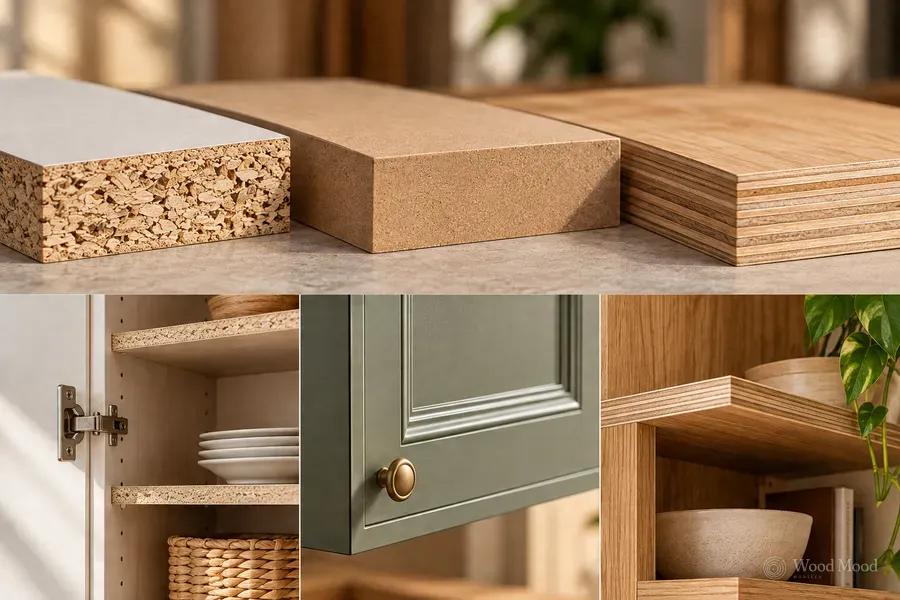
Chipboard: made by bonding small pieces of wood with binders and pressing them. Because it is economical and comes in many decorative finishes, it is used mainly for cabinet carcasses.
MDF: a board of uniform structure made by pressing wood fibres. Its smooth surface and the ease with which it can be shaped make it suitable for lacquered doors and decorative panels.
Plywood: made by gluing thin wood veneers together with the grain directions crossed. The layered construction can be an advantage where strength and screw fixings are needed.
Where is chipboard used?
Chipboard is widely chosen for the carcasses of kitchen units, wardrobes, bookcases and storage units.
Melamine-faced chipboard in particular offers ready-to-use surfaces in a range of colours and wood effects.
Advantages:
- It is economical and widely available.
- It comes in many colours and decors.
- Melamine-faced surfaces are easy to clean.
- It suits carcasses and short shelf spans.
Points to watch: cut edges must be protected against water. On long shelves, heavy loads can cause sagging, so thickness and supports need to be planned correctly.
In damp areas, suitable boards such as the P3 class under EN 312 can be considered. Moisture resistance does not mean, however, that the material is fully waterproof.
Which furniture is MDF chosen for?
The most important property of MDF is its uniform structure. This means its surface can be routed, decorative grooves can be cut and the edges can be profiled.
It is widely used for both modern and classic furniture doors.
Main uses:
- Matt and high-gloss lacquered cabinet doors
- Wood-veneered furniture surfaces
- Routed and decorative door styles
- TV units and wall panels
- Bespoke furniture pieces
MDF can be heavier than many chipboards of the same thickness. For large doors, suitable hinges and fixings must therefore be used.
For areas such as bathrooms and utility rooms, moisture-resistant MDF.H grade can be considered. Exposed edges of this material also need protecting against water.
Where is plywood used?
Plywood differs from the other two boards in its cross-layered construction. Depending on the type and quality of the product, it can offer a good balance of strength and weight.
It can be a good choice for furniture parts that need secure fixings and have to carry specific loads.
Uses:
- Bookcases and shelving systems
- Furniture carcasses and structural parts
- Seating benches and bed bases
- Designs where a layered edge is wanted
- Bespoke solid wood furniture
Plywood generally costs more than chipboard. Its quality varies with the species of timber, the layer structure and the properties of the adhesive.
Plywood used in damp areas must be of a suitable service class and its surfaces must be protected.
MDF, chipboard and plywood compared
Feature | Chipboard | MDF | Plywood |
|---|---|---|---|
Cost | Generally low | Medium | Generally high |
Weight | Medium | Generally heavy | Varies by type |
Routing and shaping | Limited | Very suitable | Depends on the application |
Lacquer paint | Not suitable | Very suitable | Needs surface preparation |
Screw holding | Depends on the fixing | Good, needs care at the edge | Generally strong |
Common use | Carcass and shelves | Doors and panels | Shelves and special parts |
This comparison shows general characteristics. The density, thickness, grade and manufacturing quality of the board can change the results.
Which board should be used in which part of the furniture?
Not every part of a piece of furniture needs the same properties. Instead of using one material throughout, you can choose boards to suit each part.
- Cabinet carcasses: melamine-faced chipboard or MDF
- Lacquered doors: MDF, for its smooth surface and workability
- Wood-veneered surfaces: MDF or other boards suited to the application
- Bookcase shelves: a board or plywood of suitable thickness for the load and span
- Bathroom furniture: moisture-resistant boards and protected edge joints
- Decorative panels: MDF for routed designs, plywood for a natural layered look
What should you look for when choosing a board?
The details of the application matter as much as the name of the material.
Board thickness: the thickness used for carcasses, shelves and doors should be set according to the size and the load to be carried.
Edge banding: exposed board edges must be suitably protected against moisture and knocks.
Fixings: hinges, screws and other connections must suit the properties of the board and the load in use.
Moisture conditions: in kitchens, bathrooms and utility areas, the risk of contact with water should be assessed when choosing the material.
Emission class: for boards used in interior furniture, formaldehyde emission properties and the relevant product documents should be checked.
The right material, used the right way
There is no single best option among MDF, chipboard and plywood for every application. Each material answers different needs.
What matters is that the board suits the function of the furniture, the load it will carry and the conditions of its setting.
At Wood Mood Furniture, we choose materials for each furniture design according to the needs of the project. We settle the materials for carcasses, doors and shelves at the design stage and make the approved furniture to measure in our own factory.
Good furniture is not only furniture that looks good; it is a design in which the right materials are used in the right places.