Cabinet handles are small but important details that complete the look of furniture. Long metal handles create modern, distinct lines, while handleless doors give a plainer, more unified look.
Choosing a handle is not only a design matter, though. How easily doors open, how drawers are used, how easy cleaning is and safety are all affected by this decision.
Let us look together at the types of handle used on kitchens, wardrobes and other furniture, and at what handleless systems offer.
Bar and knob handles
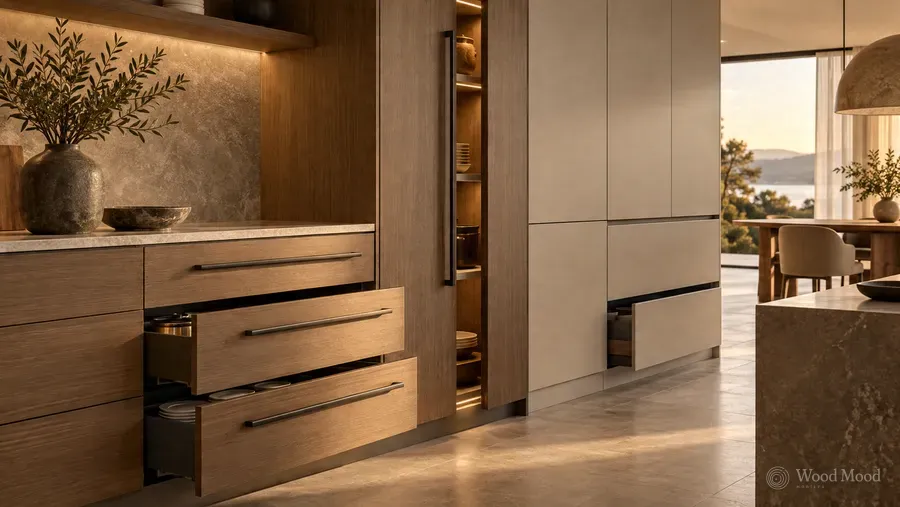
Bar handles are among the most widely used models on cabinets and drawers. They are made in different lengths, colours and materials.
They are easy to grip, which makes them comfortable to use, especially on heavy kitchen drawers. With finishes such as black, chrome, bronze and brushed metal, they can be matched to different furniture designs.
Knob handles are a smaller, more decorative option. They are chosen especially for classic kitchens, display cabinets and bedside tables.
On heavy drawers, however, small knobs are harder to grip than bar handles.
With both types, handles that project outwards are a detail to watch in narrow passages.
Profile handles
Profile handles are systems, usually made of aluminium, fitted to the top or side edge of doors.
They give a comfortable grip without projecting far from the door surface.
They are used especially in modern kitchens and on long wardrobe doors.
Advantages:
- They give a plain, unified look.
- They reduce the risk of catching compared with projecting handles.
- On long doors, they can be gripped at different heights.
- They come in different colours and finishes.
It is important that the part of the profile your fingers grip is deep enough. Dirt and dust that collect inside the profile over time may also need cleaning.
Integrated handle cabinet systems
In integrated handle systems, a channel or gap that the hand can fit into is formed behind the doors.
These channels can be made with special profiles fitted to the carcass or with suitable door edge details.
Horizontal integrated handles are used especially on kitchen base units and drawer runs.
Vertical integrated handles are chosen for tall units and wardrobes.
The main advantage of integrated handles is that nothing projects from the front of the furniture.
The channel systems fitted to the carcass can affect cabinet dimensions, however. The profile and door system to be used should therefore be decided before manufacturing begins.
Push-to-open systems
With push-to-open systems, doors and drawers open when the front is pressed lightly.
Because no handle or channel is visible from outside, the cabinet front is completely flat.
They are chosen especially for TV units, bathroom cabinets and modern kitchen designs.
Advantages:
- They give a handleless, uninterrupted look.
- There are no projecting handles.
- They suit plain door designs.
Points to watch: because the door surface is touched all the time, fingerprints can become noticeable, especially on dark and glossy colours. Doors can also open if pressed by accident.
If they are to be used together with soft-close, mechanisms suited to both features should be chosen.
Handles and handleless systems compared
Feature | With handles | Handleless-look systems |
|---|---|---|
Appearance | Decorative and prominent | Plain and unified |
Grip | Generally easier | Varies with the system |
Cleaning | Clean around the handle | Clean the channel or touch surface |
Narrow spaces | Projecting models need care | Generally an advantage |
Design variety | Very wide choice | Profile, channel and push-to-open options |
It is also possible to use both systems together in different parts of the furniture.
For example, a profile handle can be chosen for kitchen base units and a push-to-open system for the wall units.
Which handle for which furniture?
Kitchen units: on frequently used drawers that carry heavy loads, easy-grip bar or profile handles can be an advantage.
Wardrobes: long vertical handles let tall doors open easily. For sliding doors, recessed handles or suitable profile systems are chosen.
Bathroom furniture: moisture-resistant handles, profile systems and push-to-open mechanisms can be used.
TV units: for a plain look, integrated handles or push-to-open systems can be chosen.
Children’s rooms: handles without sharp corners that do not project far can be better for safety.
What to look for when choosing handles
When choosing a handle style, consider the way the furniture is used every day as well as its design.
- The handle should suit the weight of the door or drawer.
- On corner units, check that the handles will not knock against each other.
- Handle height and position should be set so that everyone who uses them can reach them comfortably.
- On wide drawers, consider the length of the handle and how comfortable it is to grip.
- Integrated handle channels and push-to-open systems should be planned before the cabinets are made.
Choosing handles to suit the design and the use
There is no single right choice between furniture with handles and without. What matters is to choose a system that suits what the furniture is for, is comfortable to use and completes the design.
At Wood Mood Furniture, we consider door styles, handle options and opening systems together at the design stage. We settle handle positions and door gaps on 3D drawings, make the furniture in our own factory and install it on site.
The right handle choice should make the furniture easier to use every day as well as completing its look.