Hinges, drawer runners and door mechanisms: the basic options
Doors that close quietly, drawers that open easily and moving parts that work without trouble for years depend largely on the mechanisms used.
Hinges, drawer runners and special opening systems are used in a great deal of furniture, from kitchen units to wardrobes. The right mechanism makes daily use easier and also adds to the life of the furniture.
What is a concealed hinge and what types are there?
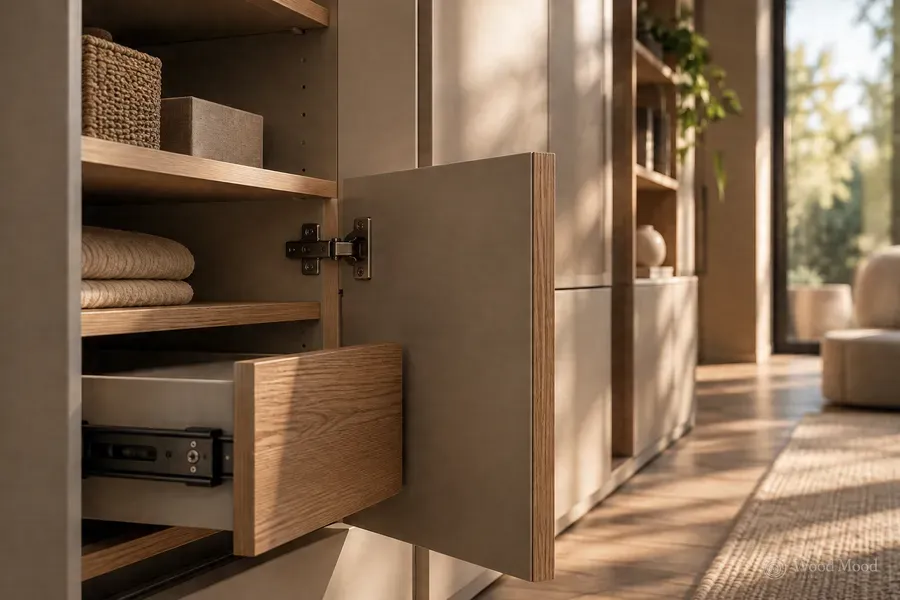
Concealed hinges are among the most widely used fixings in modern cabinets. They cannot be seen from outside when the door is closed, and on most models the position of the door can be adjusted in several directions.
There are three basic types of hinge, depending on how the door sits against the carcass:
- Full overlay: the door largely covers the side panel of the cabinet.
- Half overlay: two doors side by side share a common carcass panel.
- Inset: the door sits inside the cabinet carcass, flush with the side panels.
Besides standard hinges, there are special models for wide opening angles, for corner units and for doors with aluminium frames.
When choosing a hinge, consider the weight, height and opening angle of the door.
Soft-close hinges and slow-closing systems
Soft-close hinges have a mechanism that slows the door as it closes. This stops doors from slamming and makes for quieter use.
These systems are chosen especially for kitchen, bathroom and wardrobe doors.
Advantages:
- They let doors close in a controlled way.
- They reduce slamming noise.
- They limit sudden shocks to the door and carcass.
- They make daily use more comfortable.
On tall and heavy doors, the number of hinges matters. The number needed and where they go should be set according to the door dimensions and the manufacturer’s technical values.
Types of drawer runner
Drawer runners determine how far the drawer opens, how much it can carry and how smoothly it moves.
Roller runners
These are simple, economical runner systems. They are generally used in drawers that carry light loads.
On most models the drawer cannot be pulled fully out. For deep, heavily used kitchen drawers, more advanced systems may therefore be preferable.
Ball-bearing telescopic runners
These runners work on metal profiles and ball bearings. They move smoothly and are made in different load capacities.
Full-extension models give easy access to the back of the drawer as well.
Options with soft-close are available.
Concealed drawer runners
These are fitted under the drawer and cannot be seen from the sides when the drawer is open.
They give a clean look, especially with timber drawer boxes. Models are available with full extension, soft-close and different adjustment options.
Metal-sided drawer systems
The sides of the drawer are made of metal profiles. The runner and the drawer box work as one system.
They are often chosen in kitchens for pan, plate and dry goods drawers.
When choosing a runner, consider load capacity, full extension and soft-close together.
Push-to-open systems
Push-to-open mechanisms let doors and drawers open without a handle.
When the front of the door or drawer is pressed lightly, the mechanism engages and pushes the door out.
They are used especially in flat, handleless furniture designs.
They may not be equally practical for every cabinet, however. In frequently used lower drawers in particular, they can open when touched by accident.
Where soft-close and push-to-open are to be used together, systems that are compatible with each other should be chosen.
Lift-up door mechanisms
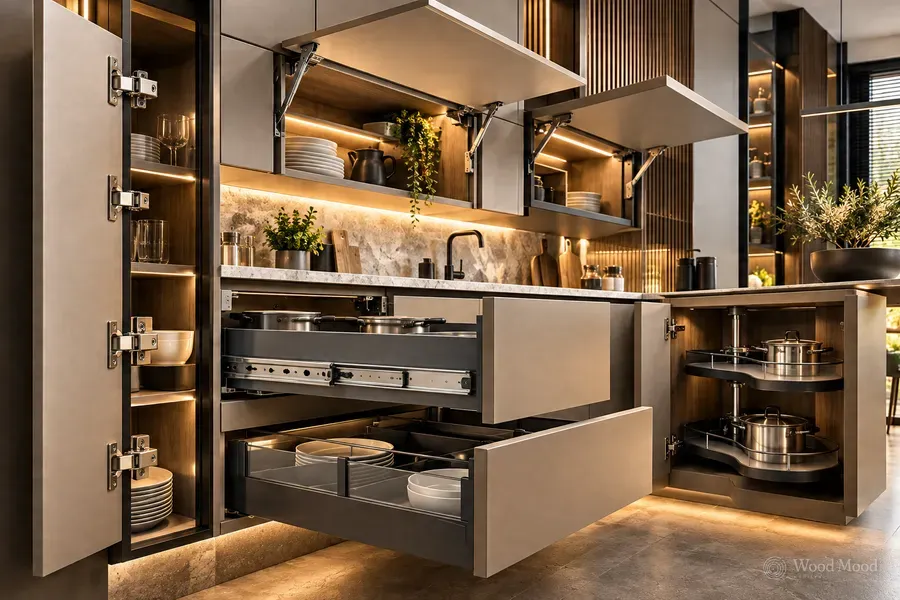
On kitchen wall units, mechanisms can be used that make the door move upwards instead of opening to the side.
These systems make it easier to use the space in front of the cabinet while the door is open.
The main types are as follows:
- Bi-fold lift-up door: a two-part door folds in the middle and lifts upwards.
- Parallel lift-up door: the door rises parallel to the front plane.
- Upward-swing door: the door pivots open from its top fixing.
- Gas-strut system: a gas or other support mechanism lifts the door.
With these mechanisms, the size and weight of the door are decisive. A mechanism chosen at the wrong strength can make the door hard to open or let it close unintentionally.
On tall wall units in particular, think about whether the handle can be reached comfortably when the door is open.
Sliding doors and corner unit systems
Sliding doors used on wardrobes do not need a wide clear area in front of them to open. They can therefore be a good choice in narrow bedrooms.
There are different sliding systems, top-hung and bottom-running. Choosing a track and wheels suited to the weight of the door is important for the mechanism to work properly.
In kitchen corners, carousel shelves, pull-out baskets and special corner mechanisms can be used.
These systems make it possible to use parts of a unit that are hard to reach in cabinets with ordinary doors.
Corner mechanisms need specific cabinet dimensions, however. The system to be used should therefore be chosen before the cabinets are made.
How do you look after hinges and runners?
For quality hardware to keep working properly for a long time, correct use and small adjustments when needed are important.
- When the gaps between doors become uneven, check the hinge adjustments.
- Tighten loose fixing screws as appropriate.
- Clean dust and crumbs that build up inside the runners.
- Do not put more in drawers than the load capacity the manufacturer states.
- Do not oil hinges and runners unless the manufacturer recommends it.
- If the soft-close action fails, check the mechanism.
Most modern concealed hinges have height, side and depth adjustments. With these, the alignment of the doors can be corrected after installation.
How do you choose the right mechanism?
With furniture mechanisms, the most expensive system is not always the most suitable option.
In a frequently used kitchen drawer, a full-extension, soft-close runner with a high load capacity can be an important advantage. In a rarely used drawer that holds light items, simpler systems may be enough.
For example, in a handleless design, an integrated handle can be more practical than a push-to-open mechanism in heavily used cabinets.
At Wood Mood Furniture, we assess hinges, drawer runners and door mechanisms according to the dimensions of the furniture, the weight of the doors and how it will be used. We decide the opening systems at the design stage and make the necessary door and drawer adjustments during installation.
Good furniture should not only look good; it should feel the same every time it is opened and closed.