The bathroom is one of the rooms in a home where furniture is most exposed to moisture and water. Steam after a shower, water splashing around the basin and frequent changes in temperature can wear cabinets down over time.
A wrong choice of material, poorly protected edge joints and unsuitable installation details can lead to swollen carcasses, blistering doors and rusting metal fittings.
Protecting bathroom furniture from moisture takes more than choosing a water-resistant material, though. The carcass construction, surface finish, edge treatment, worktop joints and ventilation all need to be considered together.
So why do bathroom cabinets swell? How do you choose moisture-resistant materials, and what should you look out for to make furniture last longer?
This guide covers the main points of protecting bathroom furniture from moisture, along with the right way to care for it.
How does moisture damage bathroom furniture?
One of the most common problems in bathroom cabinets is wood-based panels swelling because of water and moisture.
Cut edges, fixing holes and unprotected joints are the places where moisture can reach the core of the panel.
A panel that is exposed to water can swell over time. This can cause the surface finish to separate, the edge banding to lift and fixings to lose their grip.
The first signs usually appear on the base of the cabinet under the basin, on the lower edges of the doors or around the pipe penetrations.
The moisture affecting bathroom furniture comes from two sources:
- Direct contact with water: water splashed from the basin, drops left standing on the worktop, plumbing leaks and water left on the floor
- Moisture in the air: steam after a hot shower, condensation on surfaces and damp that builds up because of poor ventilation
In both cases, the aim is to stop water reaching the unprotected parts of the furniture.
Choosing the right carcass material for bathroom cabinets
When choosing material for bathroom furniture, appearance is not the only consideration; suitability for a damp environment matters too.
Different wood-based panels respond differently to moisture.
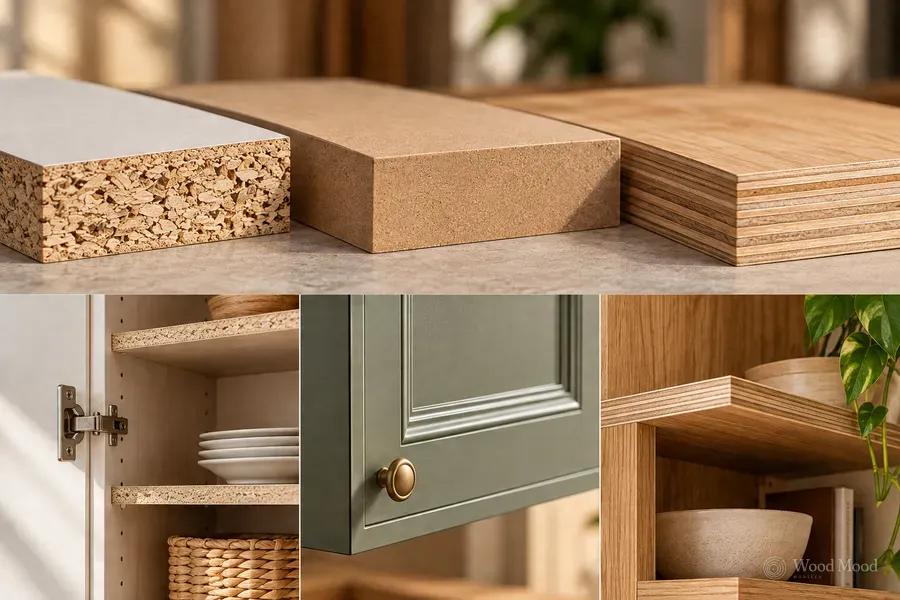
Moisture-resistant MDF
Moisture-resistant MDF is one of the wood-based panel options developed for use in damp conditions.
Products classed as MDF.H under EN 622-5 can be used in certain applications in damp environments, provided their technical properties are suitable.
Thanks to its uniform structure, it can be used for lacquered doors, decorative surfaces and specially shaped furniture parts.
That said, moisture-resistant MDF should not be treated as completely waterproof.
Cut edges, fixing holes and any areas that may come into contact with water need to be protected properly.
Moisture-resistant chipboard
Chipboard is made in several technical classes suited to damp conditions.
Class P3 under EN 312 is defined for non-load-bearing applications in damp conditions.
When using chipboard in bathroom furniture, consider the product’s technical class, the load the cabinet will carry and the fixing requirements together.
A suitable surface finish and edge protection also matter for how well the material performs in use.
Plywood
Plywood is a panel material made by bonding thin layers of wood with the grain running in different directions.
Products of a suitable class can be used in a range of furniture applications because of their dimensional stability.
The adhesive system and technical properties of any plywood chosen for bathrooms must suit damp conditions.
It is also important to protect the layered edges and to avoid direct contact with water.
Is moisture-resistant material waterproof?
One of the most common misconceptions about bathroom furniture is that moisture-resistant materials are not affected by water at all.
In fact, moisture resistance and waterproofing are not the same property.
In certain damp conditions, moisture-resistant panels can perform better than standard products. However, if they stay in water for a long time or take in water continuously through open edges, they can still distort.
The right carcass material therefore needs to be backed up by suitable surface treatments and protective joint details.
These details matter most in units under the basin and in sections close to the water supply.
Why edge banding matters in bathroom furniture
On cabinet doors and carcasses, the cut edges of the panels are among the most vulnerable points where moisture can get in.
Edge banding seals these surfaces, giving a neater appearance and helping to protect against moisture and everyday use.
However, protecting only the edges you can see may not be enough.
The underside, back and cut surfaces near the plumbing should also be finished to suit the conditions of use.
Quality of edge banding application
The application method matters as much as the quality of the edge banding itself.
Systems with high moisture resistance, such as PUR-based adhesives, can help protect edge joints when applied under suitable conditions.
There should be no gap between the banding and the panel, the edge should bond evenly, and the joint should suit the conditions of use.
Check the edge details carefully, especially on the lower sections of basin units and in areas open to splashing.
Protecting plumbing cut-outs
In units under the basin, openings are cut in the carcass for water supply and waste pipes.
If the cut surfaces of these openings are left unprotected, the panel can absorb water directly in the event of a leak.
Pipe penetrations should therefore have suitable sealing and surface protection details.
Leave enough access space as well, so that any plumbing faults can be dealt with.
Choosing the surface for bathroom cabinet doors
During everyday use, bathroom furniture doors can come into contact with damp air, water splashes and cleaning products.
When choosing a door, consider the protective properties and care requirements of the surface as well as how it looks.
Lacquered doors
Lacquered surfaces come in a range of colours and sheens and work well in modern bathroom designs.
Finishing the front and edges of the doors with a suitable paint system gives a continuous surface.
However, cracks and impact damage to the surface can let moisture reach the material beneath.
It is important to deal with this kind of damage before it spreads.
Natural wood veneer
Natural wood veneer can give a bathroom a warm look with plenty of character.
Real wood surfaces need suitable protective treatment before they can be used in damp environments.
It is important to protect the edges and backs of the doors and to avoid long-term contact with water.
Solid wood
Solid wood stands out for its natural grain.
It can expand and contract with the moisture in its surroundings. The type, construction and protective surface treatment of any solid wood parts used in bathrooms therefore need to be chosen with care.
Regular ventilation and suitable care help these pieces last.
Waterproofing at worktop and basin joints
The area around the basin and worktop is one of the parts of bathroom furniture that comes into contact with water most.
Water splashed during everyday use can collect along the basin edges and where the worktop meets the wall in particular.
Without adequate sealing in these areas, water can reach the cabinet carcass over time.
Choosing the worktop material
For bathrooms, you can consider quartz composite, natural stone and porcelain worktops, as well as acrylic composite or ceramic solutions with an integrated basin.
Each material behaves differently with water, stains and cleaning products.
When choosing a worktop, look at the basin model, the connection details and the daily care it needs as well as the surface properties.
Basin and wall joints
With countertop or undermounted basins, the points where the basin meets the worktop must be sealed properly.
The rear joint where the worktop meets the wall must also be protected.
The sealants used in these areas must suit bathroom conditions and the materials being joined.
Even a small gap can let water into the cabinet over time, so it helps to check the joints regularly.
Choosing hinges, drawer runners and handles
In bathroom furniture, it is not only the wood surfaces that moisture can affect; metal connectors and moving hardware are affected too.
Hinges, runners, screws and handles without suitable protection can corrode over time.
This can affect both the appearance of the furniture and the way the doors and drawers work.
For bathroom cabinets, choose hardware with corrosion-resistant coatings or stainless steel suited to the conditions of use.
Check the product specifications to confirm that soft-close hinges and drawer systems are suitable for a damp environment.
Handles that are easy to clean and have no details where water can collect make daily care easier.
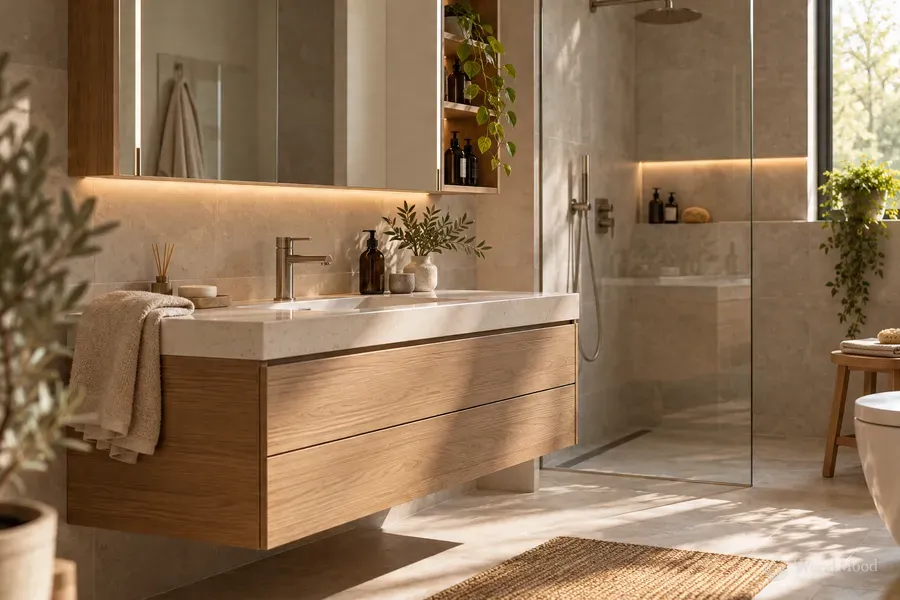
Advantages of wall-hung bathroom cabinets
Wall-hung basin units are among the most popular designs, particularly in modern bathrooms.
With these models, the cabinet carcass does not touch the floor.
This can reduce the risk of puddles on the floor reaching the lower edges of the cabinet.
The floor beneath the cabinet is also easier to clean, and the bathroom can look more open.
With wall-hung cabinets, however, the safety of the fixing is very important.
Take into account the structure of the wall, the weight of the cabinet itself, the load of the worktop and basin, and whatever will be stored inside.
The fixings and the mounting system must be suitable for these loads.
Protecting floor-standing cabinets from the floor
For bathroom cabinets that stand on the floor, you can choose suitable feet or a raised plinth detail.
These help keep the carcass out of direct contact with water on the floor.
The materials used for the feet and plinth should also be suited to bathroom conditions.
Maintaining silicone and sealing details
Where worktops meet walls, bathroom furniture has sensitive points through which moisture can reach the back of the cabinet.
Suitable bathroom silicone and other necessary sealing methods can be used in these areas.
However, silicone is not a maintenance-free solution.
Over time, silicone can separate, crack or deteriorate.
We recommend checking regularly behind the basin, at worktop corners and at joints close to water.
If you notice that it has lifted or deteriorated, renewing it properly can help prevent water leaks.
Why plan access to the plumbing?
In units under the basin, the trap, water connections and isolation valves sit inside the furniture.
Being able to reach these connections matters for spotting leaks early and making maintenance easier.
The cabinet design should therefore not close off the plumbing points completely.
In basin units with drawers, you can use special drawer cut-outs shaped around the position of the trap, or compartmented systems.
This keeps access to the plumbing while still making use of the storage space inside the cabinet.
How does bathroom ventilation protect furniture?
Ventilation plays an important part in keeping bathroom furniture in good condition for a long time.
Without enough air circulation, steam from a hot shower can condense on cabinet doors, mirrors and wall surfaces.
Repeated heavy moisture can cause problems over time on the surfaces and joints of the furniture.
Adequate ventilation in the bathroom is therefore necessary.
Bathrooms with a window
In bathrooms with a window, ventilating for a suitable length of time after a shower helps clear the moisture that has built up.
However, the weather and the layout of the bathroom can affect how well natural ventilation works.
Bathrooms without a window
In bathrooms with no window, or where natural ventilation is poor, a suitable mechanical ventilation system becomes important.
Running the extractor fan for long enough after a shower can help remove the damp air.
It also helps not to leave damp items inside closed cabinets, and to air the cabinets when needed.
Moisture safety in bathroom lighting
Illuminated mirrors, LED systems inside cabinets and decorative lights are popular choices in bathroom design.
Because water and electricity are present together, the safety requirements for these installations need careful attention.
The protection rating of electrical equipment must suit how close it is to water and comply with the relevant electrical safety regulations.
Decide the positions of mirror backlighting, LED systems inside cabinets and socket connections at the design stage.
Electrical wiring and connections should be carried out by a qualified electrician in line with the regulations in force.
How to care for bathroom furniture day to day
The right materials and installation details are a large part of protecting bathroom furniture.
Daily habits can also directly affect how long the furniture lasts.
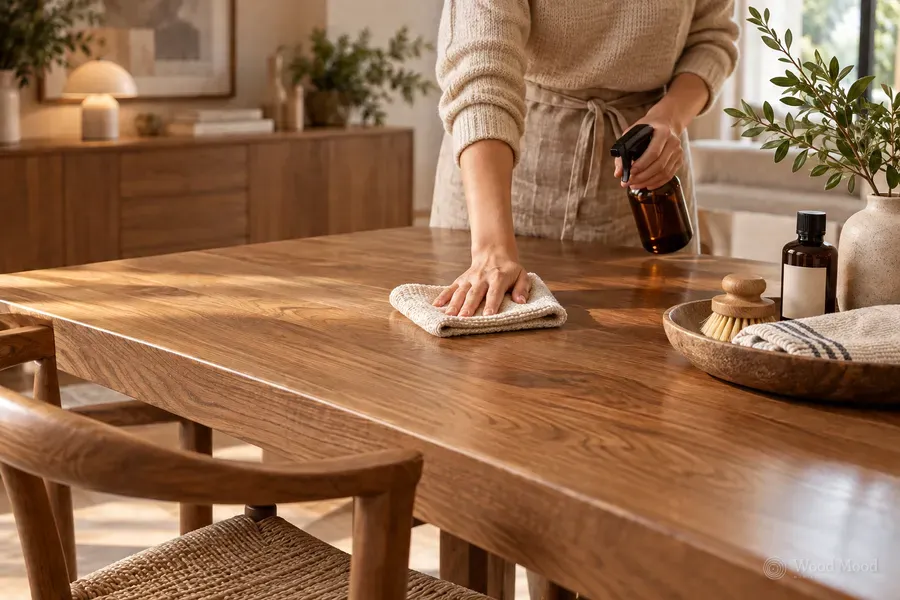
You can follow these care steps for bathroom cabinets:
- Wipe up standing water: Do not leave water splashed around the basin and on the cabinet doors for long.
- Ventilate the bathroom: Make sure the moisture left after a shower is cleared.
- Use a soft cloth: Clean the furniture surfaces with suitable, non-abrasive products.
- Avoid strong chemicals: Take care that limescale removers and similar cleaning products do not touch the furniture surfaces.
- Check the edges: Look for lifting in the edge banding or at surface joints.
- Inspect the silicone joints: Have any areas that are separating or cracking redone properly.
- Check the plumbing: If you notice damp, a smell, staining or blistering under the basin, have it checked for possible leaks.
- Review the hardware: Make sure the hinges, drawer runners and fixings work properly.
These small habits can help you spot moisture-related problems before they grow.
6 common mistakes with bathroom furniture
- Treating moisture-resistant material as fully waterproof: Overlooking that long-term contact with water can still cause damage
- Leaving edges and cut surfaces unprotected: Creating openings through which water can reach the core of the panel
- Neglecting basin and worktop joints: Allowing small leaks to swell the cabinet carcass over time
- Using unsuitable hinges and fixings: Dealing with rust and operating problems in a damp environment
- Leaving ventilation inadequate: Letting moisture from showers stay on cabinet surfaces and in enclosed spaces for a long time
- Ignoring the first signs of damage: Letting a small lifted edge or a plumbing leak turn into more serious damage to the furniture
The advantage of made-to-measure bathroom furniture
Bathrooms differ in size, plumbing positions and the way people use them.
Standard-size cabinets cannot always give the layout you want, particularly in narrow bathrooms or where pipework projects into the space.
Made-to-measure furniture design lets the cabinets be planned around the features of the available space.
Plumbing voids under the basin, drawer layouts, cabinet height and worktop joints can all be worked out at the project stage.
This produces solutions that are better suited not only to storage capacity but also to moisture protection and access for maintenance.
At Wood Mood Furniture, when we design bathroom furniture we consider the room dimensions, the basin and plumbing positions, the material options and how you use the space together. Once approved, we manufacture the cabinets to measure in our own factory and install them on site to match the plumbing connections.
The lifespan of bathroom furniture is not decided by a moisture-resistant material alone; planning every joint, fixing and detail correctly matters just as much.