Keeping a kitchen in order depends less on the number of cupboards than on how the storage is planned. Pulses, pasta, tinned food, flour, sugar, oils, breakfast items and home-made preserves can fill a large part of the kitchen cupboards over time.
Without enough well-organised storage, food ends up in the back corners of wall units, in assorted drawers or in spaces outside the kitchen. That makes products harder to reach and makes it harder to keep track of what is in the house.
A well-planned larder helps you store food in suitable conditions, find it easily and make better use of the kitchen’s storage space.
You do not necessarily need a separate room for a practical larder, either. A tall unit running up to the ceiling, a narrow gap between two units or a made-to-measure shelving system can all serve as a larder.
So how should a larder unit be planned? How deep and how high should the shelves be? How do you choose between pull-out larder systems, tall units and walk-in pantries?
In this guide, we look at larder types, the right shelf dimensions, food storage conditions and solutions for orderly storage in the kitchen.
Where should you start when planning a larder?
The first step in larder design is to work out how much you will store and how often you use it.
Not every home needs a larder of the same size. Shopping habits, the number of people in the household and how often you cook at home all directly affect the storage capacity you need.
For example, a small family that shops weekly has different larder needs from a large family that buys staples in big packs.
Before planning, it helps to answer these questions:
- Shopping frequency: Do you shop daily, weekly or monthly?
- Quantity of food: Do you store flour, rice, pulses and pasta in large packs?
- Home-made products: Do you make winter preserves such as jam, pickles, tomato paste and canned goods?
- Small appliances: Will the blender, mixer or bread maker be kept in the larder?
- Drink storage: Do you need space for water bottles, drinks or large packs?
- Number of users: How many people will the larder serve?
With this information, the items to be stored can be grouped.
One practical way to see how much storage you need is to gather the dry foods from your current kitchen and judge the volume they take up.
It also helps to leave some spare capacity in the plan for quantities that may grow later.
Where should the larder go in the kitchen?
The position of the larder matters as much as its capacity.
Keeping the area where everyday food is stored close to the fridge and the food preparation worktop can reduce movement in the kitchen.
For example, with pulses, pasta and tinned food in a unit near the preparation area, you do not need to walk between different cupboards while cooking.
As far as possible, then, the larder should be thought of as part of the kitchen’s food storage area.
Not all products have to be stored in the same place, however.
Foods you use often can be kept in a larder unit within the kitchen, with spare stock and bulk purchases in a separate storage area near the kitchen.
In larger homes in particular, it is worth planning a larder unit for everyday use together with a bigger stock area.
When choosing the position, also check the temperature, humidity and exposure to daylight in that spot.
What types of larder unit are there?
Larders can be designed in different ways, depending on the size of the space and the storage needed.
Tall larder units, narrow pull-out units, wall niches and walk-in pantries are among the most common options.
Each system differs in storage capacity, ease of access and the space it needs.
Tall larder units
Tall larder units are storage units designed in line with the kitchen cabinets, usually running up to the ceiling.
They suit homes without a separate pantry in particular.
A width of about 45–60 cm and a depth of 55–60 cm work in many layouts.
The exact dimensions should be decided according to the kitchen layout and the internal mechanism.
The main problem with deep tall units is that products at the back can be hard to reach.
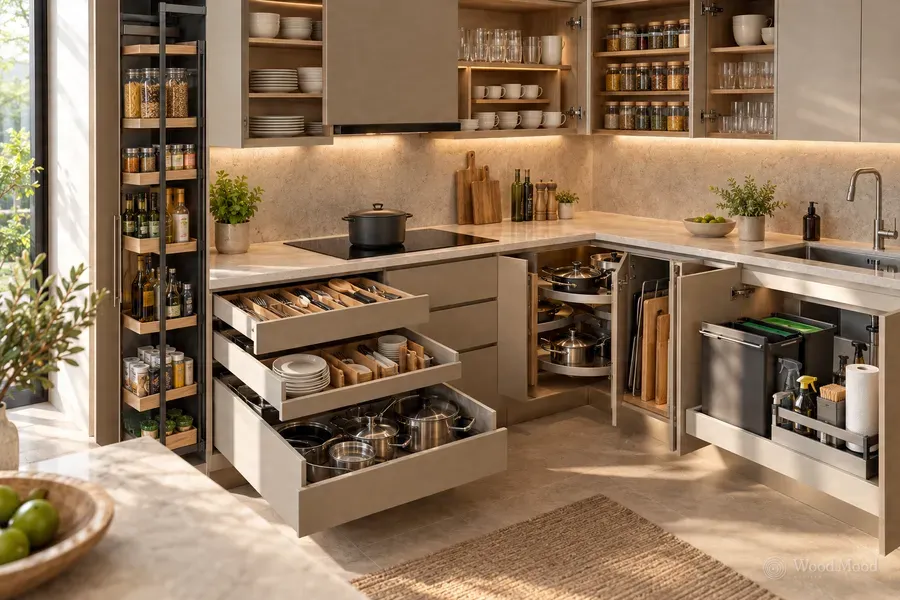
Internal drawers or pull-out shelving can therefore be used instead of fixed shelves alone.
Larder units with internal drawers
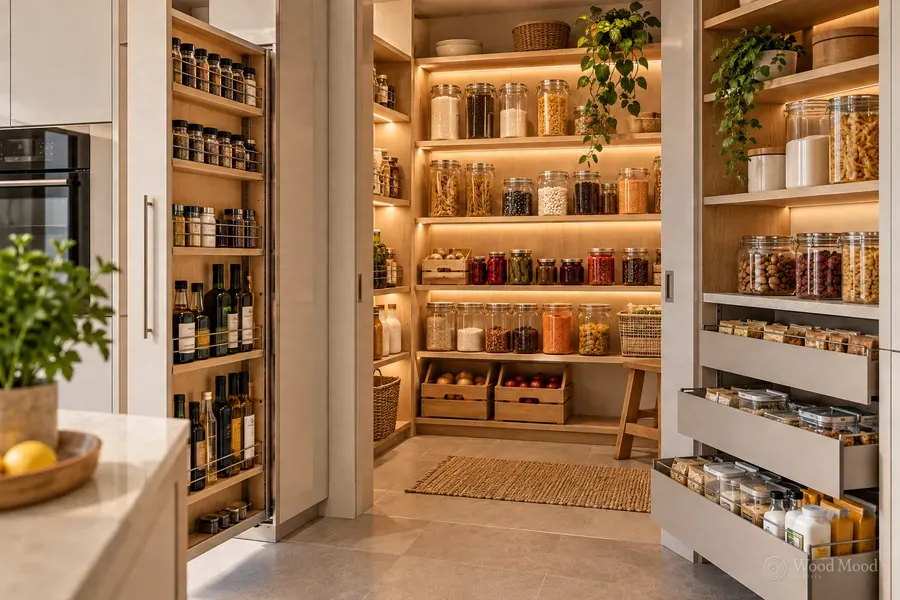
Independent drawers fitted behind the door pull the products out towards you.
This makes it easier to reach the packets and jars stored at the back.
The height of the drawers can be designed to suit the items to be stored.
For example, shallow drawers can be used for small tins and spices, and taller drawers for large packs and bottles.
Pull-out shelving
Full-extension shelves can help you make better use of the depth of the unit.
The load capacity of the mechanism is important, however.
Where heavy items such as glass jars and tins will be stored, choose runners and fixings with a suitable load rating.
Narrow pull-out larder units
In kitchens, narrow gaps between two units or beside the fridge cannot always be filled with standard cabinets.
Narrow pull-out larder systems can be used in these spaces.
Units with a suitable mechanism, which can be made about 15–30 cm wide, are worth considering for storing spices, oil, vinegar, tins and bottles.
With these systems, when the shelf unit is pulled forward, the products can be reached from the sides.
The advantage of narrow larders is that they provide vertical storage on a small floor area.
With tall, narrow mechanisms, load distribution, the strength of the fixings and the load capacity must be assessed with care.
Oils and spices should also be positioned so that they are not exposed to direct heat from the hob.
Larder niches with doors
Niches in the kitchen wall, or recesses between two structural elements, can be turned into a larder with made-to-measure shelving.
Doors can be fitted in front of these spaces to create a tidy storage section.
Larder niches with doors can contain open shelves, drawers or sections of different depths.
In suitable designs, pocket door mechanisms are also worth considering.
When open, doors like these may interfere less with the passage in the kitchen.
For a door system to work, the carcass clearances and mechanism dimensions need to be established in advance.
Shallow wall larders
In narrow spaces, a deep cupboard is not always the better choice.
For sections that will hold small packets, spices and tins in particular, shallower shelves can be a good choice.
Shelves about 15–30 cm deep allow single-row storage for suitable products.
This way, products can be seen without being stacked on top of each other or placed one behind another.
These systems can be used at kitchen entrances, on suitable hallway walls or in architectural niches.
When deciding the shelf depth, take into account the actual dimensions of the jars and other products.
Walk-in pantries
Walk-in pantries can be used in homes where a separate room or a large area can be set aside for storage.
In these systems, the shelves are placed on different walls around the user.
Dry foods, preserve jars, drinks and small appliances can then be stored in the same space.
In larger pantries, there can be drawers, cupboards with doors and, where conditions allow, a small work surface as well as shelves.
Do not narrow the walkways more than necessary just to add more shelving, though.
What storage conditions should a larder have?
In larder design, storage capacity is not the only concern; keeping the food in suitable conditions matters too.
The storage conditions for dry foods can vary with the type of product.
For many dry foods, though, a cool, dry place out of direct sunlight is preferred.
High temperature, excess humidity and strong light can cause some products to deteriorate faster.
The position and ventilation of the larder should therefore be considered carefully.
Distance from heat sources
Avoid placing larder units where they are exposed to strong heat.
Check the temperature conditions around the oven, hob, radiators and appliance hot-air outlets in particular.
If a larder is to be built near the fridge, the appliance’s ventilation clearances must be kept and excess heat must not pass into the larder.
Moisture control
Moisture matters especially for storing flour, pulses and dry foods.
High humidity can cause clumping and mould, and make products deteriorate faster.
The existing humidity conditions of the larder space should therefore be assessed.
In an area that has had damp problems before, do not plan food storage until the source of the problem has been put right.
Air circulation
Air circulation matters in walk-in pantries and in closed cupboards with poor ventilation in particular.
Suitable ventilation openings or, where necessary, mechanical ventilation are worth considering.
An opening in the door alone does not mean there is enough ventilation in every situation, however.
Take into account the size of the larder and the environment it is in.
Protection from light
Oils, spices and some dry foods can lose quality when exposed to direct light.
Closed cupboards out of direct sun, or suitable storage containers, can therefore be a good choice.
In larders with glass doors, opaque containers can be used for light-sensitive products.
The storage instructions on the product packaging should always come first.
How should you store potatoes, onions and dry foods?
Not all the foods kept in a larder have the same needs.
Different conditions may be needed for vegetables, opened packets of dry food and home-made products in particular.
Potatoes and onions
Potatoes and dry onions should be stored in a cool, dry, dark and airy place that suits the product.
Baskets that allow air to circulate, or compartments with suitable openings, are worth considering for these products.
Storing potatoes and onions in separate compartments can help to reduce loss of quality.
It is important not to leave wet or spoiling produce with other foods for long.
Flour, rice and pulses
Keeping opened dry foods in suitable, clean containers with lids can help to protect them from moisture and pests.
Transparent containers make it easy to see how much is left.
The storage information and best-before dates on the original packaging should also be kept.
Spices and oils
Spices and oils should be protected from direct sunlight and strong heat.
The ambient temperature should be assessed in narrow larder units beside the hob in particular.
Closed compartments at a suitable temperature are a good choice for these products.
How deep should larder shelves be?
Shelf dimensions are one of the main factors in how easy a larder is to use.
On very deep shelves, products line up one behind another and the ones at the back can be forgotten over time.
On shelves that are too shallow, there may not be enough room for large packs and bottles.
Shelf depth should therefore be set according to the size of the products to be stored.
Shelf depth
For jars, tins and packets of dry food, shelves about 30–40 cm deep are a good starting point in many layouts.
These dimensions can make it easy to place products comfortably.
In deeper units, drawers or pull-out shelves are worth considering instead of fixed shelves.
It is especially important not to put frequently used products at the very back.
Shelf height
The distance between larder shelves should also be set according to the height of the products.
As a general planning guide, consider these shelf spacings:
- Small jars and tins: about 20–30 cm
- Large packets and bottles: about 35–40 cm or more
- Small spice jars: shallower sections to suit the product size
- Large kitchen equipment: purpose-made shelves to suit the actual height of the appliance
These figures are not exact measurements.
Adjustable shelves make it easier to store products of different sizes and to reorganise as your needs change.
Shelf load capacity
A larder shelf can hold many glass jars, tins and large packs.
The combined weight of these products can put a significant load on long shelves in particular.
Shelf thickness, span and fixing system should therefore be set according to the load they will carry.
On wide shelves, intermediate uprights or suitable supports should be used where necessary.
Where should heavy and light items go?
Storing products at the right height in the larder matters for both access and safety.
Large glass jars and heavy packs in particular can be difficult to lift down from high shelves.
When placing products, take weight into account as well as how often you use them.
Lower sections
Low, easy-to-reach storage is worth considering for flour, sugar, large packs of rice, drinks and heavy glass jars.
Wide drawers with a suitable load capacity can be used for this.
Middle sections
Pasta, pulses, breakfast items and tinned goods used every day can be kept on shelves between waist and eye level.
This arrangement makes it easy to reach products without bending down or stretching up to high shelves.
Upper sections
Upper shelves can be kept for light items and those used rarely.
We advise against storing heavy jars, large drink packs or anything that could fall in the highest sections.
Storage on the back of larder doors
In some larder designs, the inside face of the doors can also be used for storage.
Shallow shelves or suitable organisers fitted inside the door can hold small spice jars and light packets.
This can provide extra storage in wide tall units in particular.
Shelves and products added to the door put extra load on the hinges, however.
The load capacity of the door material, hinges and fixings should therefore be taken into account.
Enough clearance must also be left so that the door does not hit the inner shelves when it closes.
How do you keep a larder in order?
Having a large larder unit does not in itself make an organised storage system.
If products are put away at random, finding the food you want can be hard even in a large space.
It helps to group products according to how they are used.
Sort products into categories
Storing similar products together in the larder makes shopping and food preparation easier.
For example, you could set up these groups:
- Pulses, rice and pasta
- Flour, sugar and other baking ingredients
- Breakfast items
- Tinned and jarred products
- Spices and sauces
- Snacks
- Drinks
- Spare food stock
Setting aside a separate shelf, drawer or basket for each category helps to keep things in order.
Use storage containers
Suitable storage containers can keep opened dry foods tidy.
Containers of the same type and size in particular can help you make better use of shelf space.
Transparent containers make it easy to see how much of a product is left.
The material of the container must be suitable for contact with food, however.
Label your products
Having the product name on storage containers can prevent similar-looking foods from being mixed up.
Keep the best-before date and any necessary storage information too.
This information matters especially for products taken out of their original packaging.
Use the oldest stock first
It helps to arrange newly bought products with the existing stock, taking best-before dates into account.
Products with an earlier best-before date can be kept at the front.
This can reduce the amount of food that sits unused and passes its date.
Make use of baskets and boxes
Removable baskets can be used for small packets, snacks and tea products.
Baskets stop small products from scattering across the shelf.
The baskets you use should be easy to clean and suit the products to be stored.
How should a walk-in pantry be planned?
Walk-in pantries can offer high storage capacity in homes with suitable space.
In these systems, the shelves are usually placed on two or three walls.
As well as the width of the pantry, it matters that users can move around comfortably inside.
Walkway width
A clear passage of about 90 cm between shelves is a starting dimension that works in many homes.
Where there are two facing lines of shelving, a passage of about 100 cm or more can make it easier to move.
The exact dimension should be set according to the shelf depths, how far the drawers open and accessibility needs.
L-shaped and U-shaped shelf layouts
In pantries, L-shaped or U-shaped shelf layouts let you use different walls for storage.
An L-shaped layout uses two walls, while a U-shaped layout provides storage on three.
Deep gaps that make it hard to reach products can form in the corners, however.
The depth and use of corner shelves should therefore be planned carefully.
Larder door
The direction the larder door opens can affect the shelf space inside.
In narrow spaces, suitable sliding doors or other space-saving systems are worth considering.
The door you use must not block the passage or safe access, however.
Larder lighting
Having enough light in the larder lets you see the products easily.
Suitable artificial lighting matters on deep shelves and in pantries without a window in particular.
Sensor systems that switch on when the door opens, or shelf lighting, are worth considering.
The electrical connections should be planned to meet the relevant safety requirements.
A small worktop in the pantry
In large pantries, a small work surface can be built in beside the shelves.
This area can be used to sort products after shopping, to arrange jars or to put small kitchen items down temporarily.
The height and depth of the worktop should be set according to the users’ needs.
Some pantries can also have dedicated sections for storing small appliances.
If you plan to run these appliances inside the pantry, the electrical connections, ventilation and the manufacturer’s conditions of use must be assessed separately.
Avoid running appliances that produce heat or steam in closed or poorly ventilated sections in particular.
Home-made food and winter preserves
In many homes, the larder stores not only packaged food but home-made preparations as well.
Products such as jam, pickles, tomato paste and canned goods can be stored in glass jars of different sizes.
When arranging shelves for these products, take into account the weight and height of the jars and the storage conditions.
Shelves for glass jars
Full glass jars can be heavy.
The load capacity of the shelves should therefore be set according to the quantity of produce.
Use the necessary supports on wide-span shelves in particular.
Placing the jars so that their labels can be seen makes it easy to tell the products apart.
It is better to keep heavy jars in sections that are safe and easy to reach than on high shelves.
Safety of home-canned food
The storage conditions for home-canned food and other preparations depend on the type of product and the preparation method used.
Not every home-made product can be stored safely at room temperature.
Safe canning methods and storage conditions suited to the type of product should therefore come first.
Products that have been opened, or that need to be kept cold, should not be left in a larder at room temperature.
Storage for bottles and liquids
Oil, vinegar, pomegranate molasses and other bottled products may need sections of different heights in the larder.
To keep bottles from tipping over, suitable shelf depth and, where necessary, front retaining rails can be used.
In narrow pull-out larders especially, dividers that stop bottles falling over as the unit moves can be useful.
Removable, wipe-clean protective liners are worth considering on shelf and drawer bases.
This can make cleaning up easier after any spills.
The storage temperature and light sensitivity of liquid products should also be taken into account.
Larder units for small appliances
Small appliances that are not in constant use in the kitchen can take up a lot of space on the worktop.
Separate storage sections for the mixer, blender, food processor and similar equipment can be made in the larder.
The depth and height of the shelves for storing these appliances should be set by their actual dimensions.
Putting heavy appliances on very high shelves can make lifting them up and down awkward.
For equipment used often or heavy, shelves close to waist height and drawers with a suitable load capacity are worth considering.
In sections where appliances will be run, follow the manufacturer’s instructions on ventilation, electrical supply and safe use.
How do you create larder space in a small kitchen?
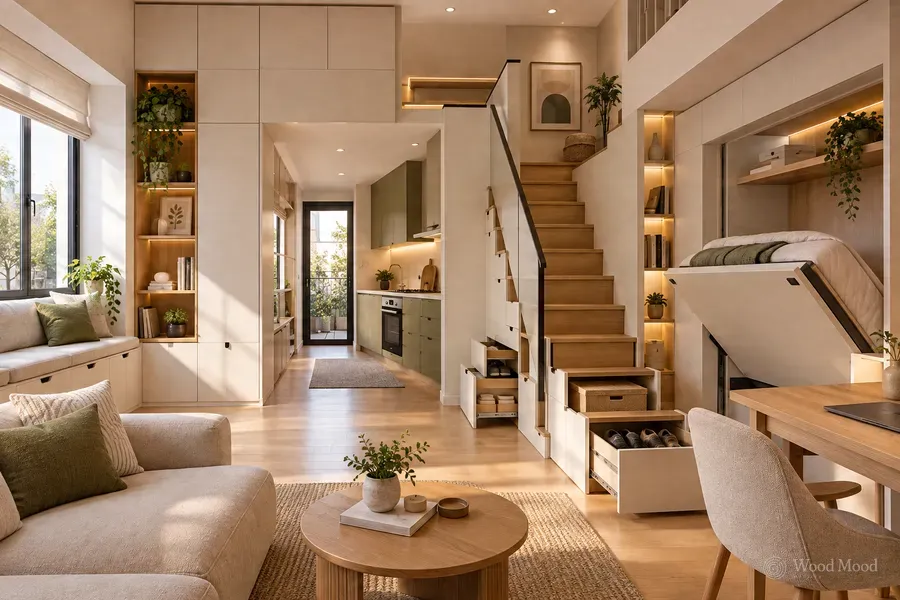
Kitchens with no room for a separate pantry or a wide tall unit can still use other storage solutions.
Making use of unused narrow gaps and wall height in particular can provide extra storage capacity.
A full-height larder unit
Extending the larder unit up to the ceiling can create extra space in the top section for rarely used items.
It is important not to store heavy items on high shelves and to provide safe access.
Narrow pull-out units
Suitable gaps between two units can be used for narrow pull-out larder systems.
These spaces suit bottles, small packets and spices in particular.
Corner larder units
Deep spaces in kitchen corners can be put to use with suitable shelves or pull-out corner mechanisms.
The actual internal dimensions of the corner unit and the door swing must suit the mechanism to be used.
Wall niches
Suitable niches at kitchen entrances or between columns can be designed as shallow larder units.
This solution can be an advantage in spaces where standard cabinets cannot be fitted.
Combining closed and open sections
Some products can be stored in closed cupboards, while suitable items you use often can be kept on open shelves.
Sunlight, dust and temperature conditions should be taken into account for open shelves, however.
Too many items on visible shelves can make the kitchen look crowded.
7 common mistakes in larder planning
1. Placing the larder too close to strong heat sources
Unsuitable temperatures near the oven, hob or appliance hot-air outlets can affect how well some foods keep.
2. Using only fixed shelves in deep units
Products at the back can become hard to reach. Drawers or pull-out shelves are worth considering where space allows.
3. Making all the shelves the same height
This can leave too much space for products of different sizes, or large packs may not fit on the shelves.
4. Ignoring the storage conditions of the food
Potatoes, onions, dry foods and home-made products can need different conditions.
5. Not storing opened food properly
Protecting dry foods from moisture and pests comes down to choosing containers and storage conditions that suit the type of product.
6. Not planning ventilation and lighting
In walk-in pantries especially, poor air circulation and light can affect the storage conditions and how easy the larder is to use.
7. Not sizing the larder to your shopping habits
A larder that is too small can fill up quickly. One that is too large and badly arranged can take up space in the kitchen for no good reason.
Advantages of made-to-measure larder units
Every kitchen has different dimensions and storage needs.
Ready-made cabinet systems offer suitable solutions in some kitchens, but made-to-measure larder furniture can be an advantage in narrow gaps, around columns or in areas that need a special shelf layout.
In a made-to-measure design, the width, depth, shelf heights and internal mechanisms of the unit can be planned around what will be stored.
For example, we can make a tall larder that integrates with the kitchen units, a narrow pull-out unit beside the fridge, or wall-to-wall shelving in a separate room.
Drawers, baskets, bottle racks and adjustable shelves can be combined to suit different storage needs.
The design should not simply aim to store as many products as possible, however.
Easy access to products, shelf load capacity, ventilation and food storage conditions should be considered together.
Placing large glass jars, heavy packs and tall bottles safely is especially important.
A tidy larder makes the kitchen easier to use
A well-designed larder does more than add storage space. It makes it easier to see what is in the kitchen, to reach what you need and to keep food in order.
The choice between tall units, narrow pull-out systems and walk-in pantries should be made according to the characteristics of the available space and the household’s habits.
Shelf depths, drawer heights, mechanism options and the storage conditions of the products should be considered at the start of the design.
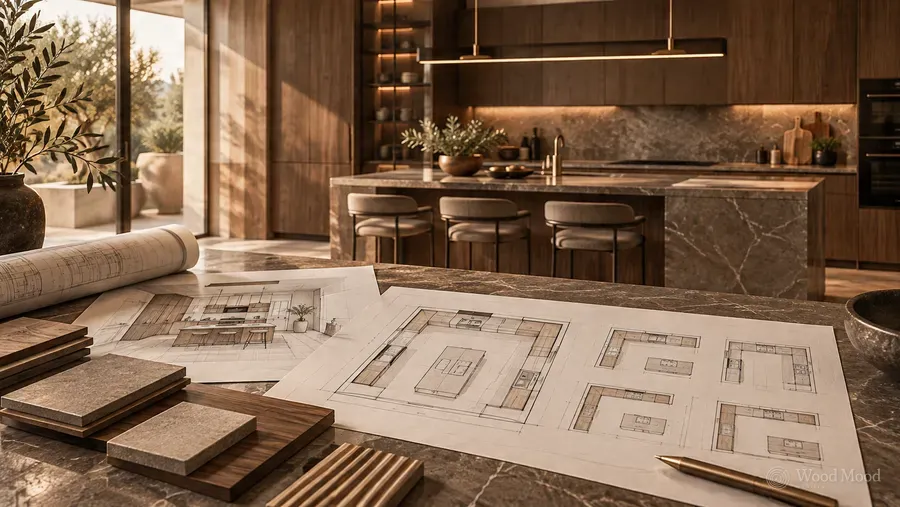
At Wood Mood Furniture, we start designing larder and kitchen storage furniture with a site survey and measuring. Together we look at the usable space, the existing kitchen layout and the types of product you will store.
We plan the shelves, drawers, tall units and special storage sections in the drawings, make the approved furniture to measure in our own factory and install it on site across North Cyprus.
The value of a good larder lies less in how much it holds than in how easily you can find everything you need.