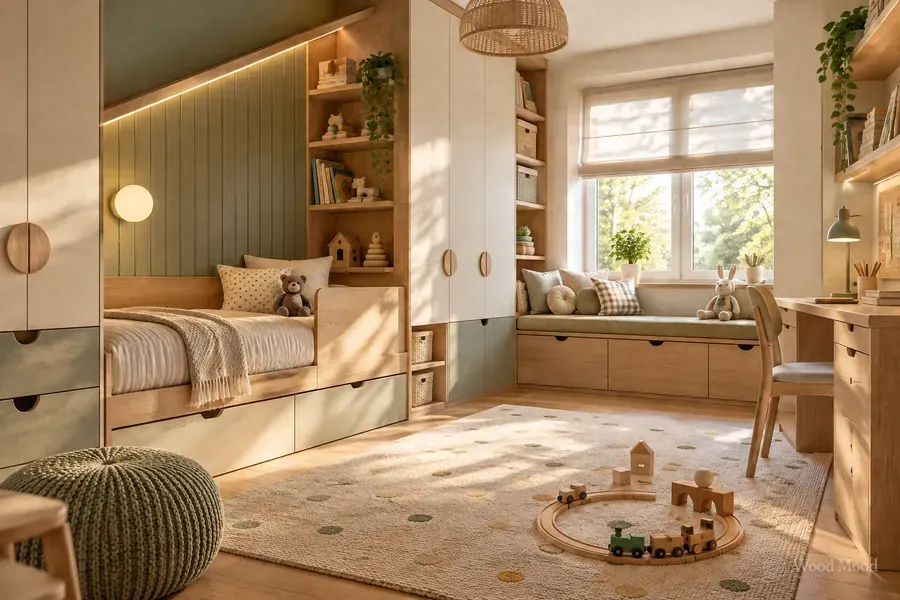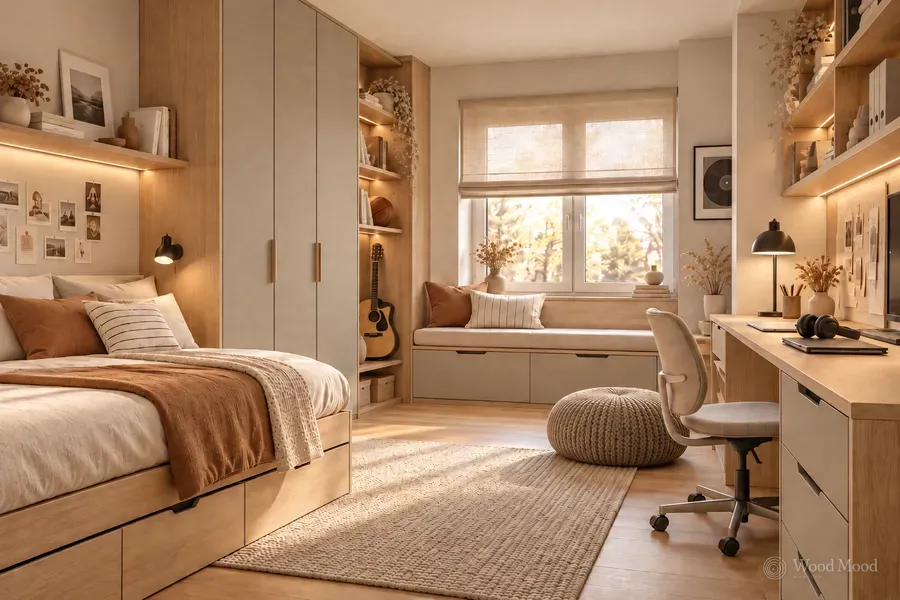
Children’s rooms are used for playing, learning and exploring as well as sleeping and resting. Because children are active and curious, furniture in their rooms needs safety measures that an adult’s room does not.
A unit that could tip over, a sharp table corner or a drawer that slams shut: these are details that go unnoticed in daily life but can be dangerous for children.
In a children’s room, safety should therefore be the starting point of the planning, not something added afterwards.
So how do you create a safe children’s room? In this guide we cover the main points to watch, from furniture choice and material properties to fixing systems and bunk bed design.
Why is fixing furniture to the wall important?
One of the most important safety issues in a children’s room is the risk of tall, heavy furniture tipping over.
While playing, children can climb on units, use open drawers as steps or hang on to bookcases. These movements can unbalance furniture that is not fixed and cause serious accidents.
Wardrobes, bookcases, chests of drawers and tall storage units should therefore be fixed to the wall with suitable fixings.
The construction of the wall must be taken into account when fixing. Concrete, brick and plasterboard walls need different fixing methods. With plasterboard in particular, the fixing must go into suitable load-bearing supports.
To improve safety further, store heavy items on the lower shelves, avoid overloading drawers and avoid furniture arrangements that children can climb.
With made-to-measure furniture, planning the fixing points before manufacturing means better fixing solutions can be applied during installation.
Safety in corners and edges
Children move quickly when they play and can run into the furniture around them. The corners of tables, bedside tables and low units can be at the height of a small child’s head and face.
Choosing rounded or softened edges instead of sharp corners reduces the risk of injury in a collision.
Edge banding on furniture surfaces must also be applied properly. Edge finishes that lift over time or leave sharp protrusions can be a risk to children.
Check that wooden surfaces are free of splinters, burrs and sharp joints.
Handle choice matters too
Handles on units and drawers are decorative, but they do a practical job too.
Handles that stick out too far or have sharp lines can catch a child running past, or snag their clothing.
In children’s rooms, consider integrated handles, rounded models and suitable profile handles.
The aim is furniture that does not get in the way of the child’s everyday movements and is free of unnecessary protrusions.
Soft-close hinges and drawer systems
Doors and drawers in a children’s room are opened and closed many times a day.
Small children in particular may push doors shut hard or close drawers without control. This increases the risk of trapped fingers and knocks.
Soft-close hinges and drawer runners slow the final part of the closing movement, so doors and drawers close in a more controlled way.
These mechanisms do not remove the risk of trapped fingers completely, however. The gaps on the hinge side in particular need separate attention.
It is also important that drawers have stops that prevent them being pulled off the runners by accident.
Toy chests and lift-up lids
Lid safety needs separate thought in toy chests and top-opening storage units.
A heavy lid that drops suddenly can hurt a child’s hands or head. Suitable lid supports and controlled-closing mechanisms should therefore be used.
For chests big enough for a child to climb into, the risks of entrapment, closing and ventilation must be assessed separately.
Windows and furniture placement
A children’s room is not made safe by the furniture alone. Where the furniture stands in the room also matters.
A bed, desk, bedside table or toy chest placed in front of a window can become a step that children use to reach it.
We therefore recommend not positioning furniture that can be climbed on around windows.
Fit age-appropriate safety measures to windows, and consider child safety locks or suitable opening restrictors.
Curtain and blind cords must also be arranged so that children cannot reach them. Where possible, choose systems with no accessible cords.
Sockets and cable management
Children’s rooms may need several electrical connections for desks, night lights, computers and decorative lighting.
Planning socket positions together with the furniture layout helps cut down on extension leads and loose cables on the floor.
On desks, cable openings, suitable cable trunking and compartments for devices can be used.
Electrical installation and socket work must be carried out by qualified electricians in line with the safety requirements in force.
For lighting built into furniture, the suitability of the equipment and the safe positioning of the cables are important too.
What to watch for with bunk beds and high beds
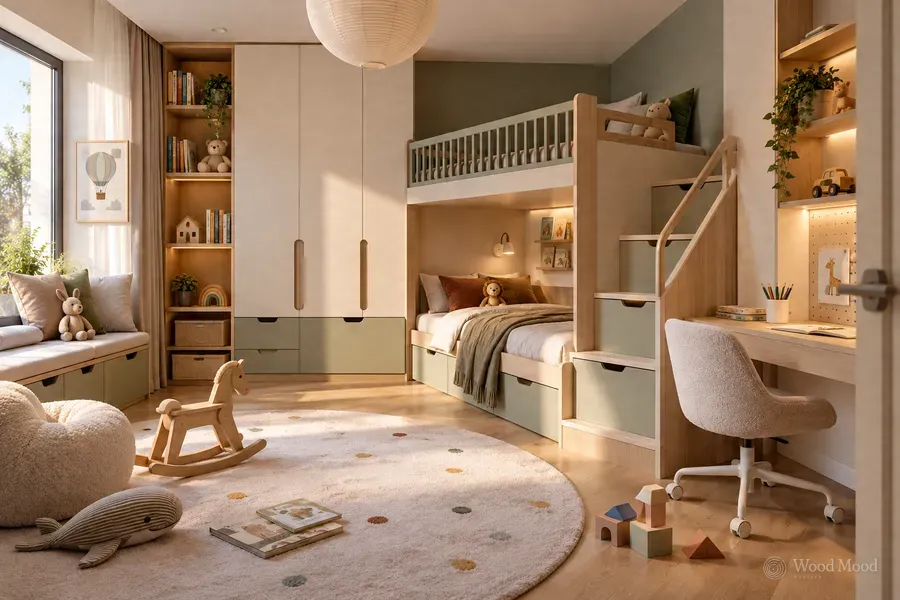
Bunk beds are a popular way to save space, especially when two siblings share a room.
However, high beds carry specific safety requirements because of the risks of falls and entrapment.
In Europe, the EN 747 standard is the reference for the safety features of bunk beds and high beds. It covers important issues such as guard rails, openings, ladders and structural safety.
The top bunk is not suitable for children under six.
When choosing a bunk bed, check these details:
- Guard rails: the top bunk should have guard rails of suitable height that give continuous protection.
- Mattress thickness: the mattress must not exceed the maximum height set by the manufacturer.
- Ladder safety: the steps should be sturdy, suitably spaced and designed to reduce the risk of slipping.
- Ceiling clearance: there must be enough space to sit up on the top bunk without hitting your head on the ceiling.
- Window position: the bunk bed should not stand where it makes climbing to the window easier.
- Use at night: consider a non-glaring night light that shows the ladder and walkway.
In bunk bed design, check compliance with the relevant safety requirements as well as appearance and size.
Choosing the right materials for a children’s room
Children spend a large part of their time in their rooms. The effect of the materials and surface treatments used in the furniture on indoor air quality should therefore be taken into account.
For MDF and other wood-based panels, formaldehyde emission values are an important selection criterion.
Panels in emission class E1, or with documented lower emission values, can be considered.
For lacquer, varnish and other surface finishes, look at the technical properties of the products, their intended use and their volatile organic compound (VOC) emissions.
Water-based products can be chosen, but being water-based alone does not mean a product meets all safety and emission requirements.
Some surface coatings can also be documented as compliant with EN 71-3. This standard covers tests on the migration of certain elements from the material; on its own it does not show that the furniture is safe in every respect.
Reviewing the relevant technical documents when choosing materials and finishes helps you make better-informed decisions for children’s room furniture.
Furniture that suits the child’s age
Children’s needs change as they grow.
In the early years, toys and play areas come first. At school age, a desk, a bookcase and more varied storage are needed.
It therefore pays to design children’s room furniture for the years ahead as well as for today.
Adjustable shelves, study units that can be added later and unit compartments that adapt to different items can help the furniture stay in use for longer.
Storage a child can reach easily
Frequently used toys, books and everyday items should be at heights the child can reach comfortably.
Low shelves and suitable storage boxes make it easier for children to take out and put away their things on their own.
This approach supports a tidy room and reduces the need to climb on furniture to reach high shelves.
Low storage units must still be assessed for the risks of tipping and trapping.
Ergonomics at the desk
For school-age children, the height of the desk and its relationship to the chair matter.
The aim is for the child’s feet to rest on the floor or on a suitable footrest, for their back to be supported when sitting, and for their arms to rest comfortably on the desk.
Height-adjustable desks and chairs can improve comfort as the child grows.
Positioning the desk so that natural light comes from the side helps reduce screen reflections and glare.
Leaving enough space around the desk, and keeping frequently used books on shelves within easy reach, also matters for everyday use.
Lighting and night-time use
Lighting in a children’s room should be planned around the different needs of the sleeping and study areas.
As well as general ceiling lighting, consider a suitable task light for the desk and low-level lighting for use at night.
Lights at the head of the bed should not shine directly into the eyes, so that children can rest comfortably.
LED lighting inside units or shelf lighting can be convenient where the necessary safety conditions are met.
The position of the lighting fittings, their cables and how hot they get should also be considered during design.
Maintenance and checks for children’s room furniture
Keeping the furniture safe throughout its life matters as much as creating a safe children’s room in the first place.
Check for fixings that work loose over time, hinges that go out of adjustment and damaged edge banding.
When the room is rearranged, in particular, the wall fixings of furniture that has been moved or reassembled should be reassessed.
Clean furniture surfaces according to the material’s care instructions, and avoid abrasive products and long contact with moisture.
On bunk beds and raised beds, review the guard rails, ladder and fixing points regularly.
6 common mistakes in children’s room design
- Using tall furniture without fixing it: this can increase the risk of tipping with units such as wardrobes, bookcases and chests of drawers.
- Ignoring sharp corners and protruding handles: these create risky points that children can run into while playing.
- Overlooking door and drawer safety: mechanisms that close without control can trap fingers.
- Placing furniture in front of the window: this can make it easier for children to climb up to the window.
- Choosing materials on looks alone: the safety and emission properties of the panels, paints and finishes used may then go unchecked.
- Not allowing for the child to grow: fixed, inflexible furniture layouts may not meet needs that change quickly.
Planning properly for a safe children’s room
Safety in a children’s room cannot come from a single feature of the furniture. The construction of the units, their placement, the materials, the fixing systems and suitability for the child’s age all need to be considered together.
Made-to-measure design takes account of the room’s architecture and how it will be used, which makes a more controlled furniture arrangement possible.
At Wood Mood Furniture, we start children’s room design with a site survey and measuring, and review the furniture layout, storage needs and safety details at the design stage. We manufacture the approved furniture in our own factory and finish the job with on-site installation and suitable fixing.
In a children’s room, good design is not only what looks good; it creates a space where children can grow up safely.